Books
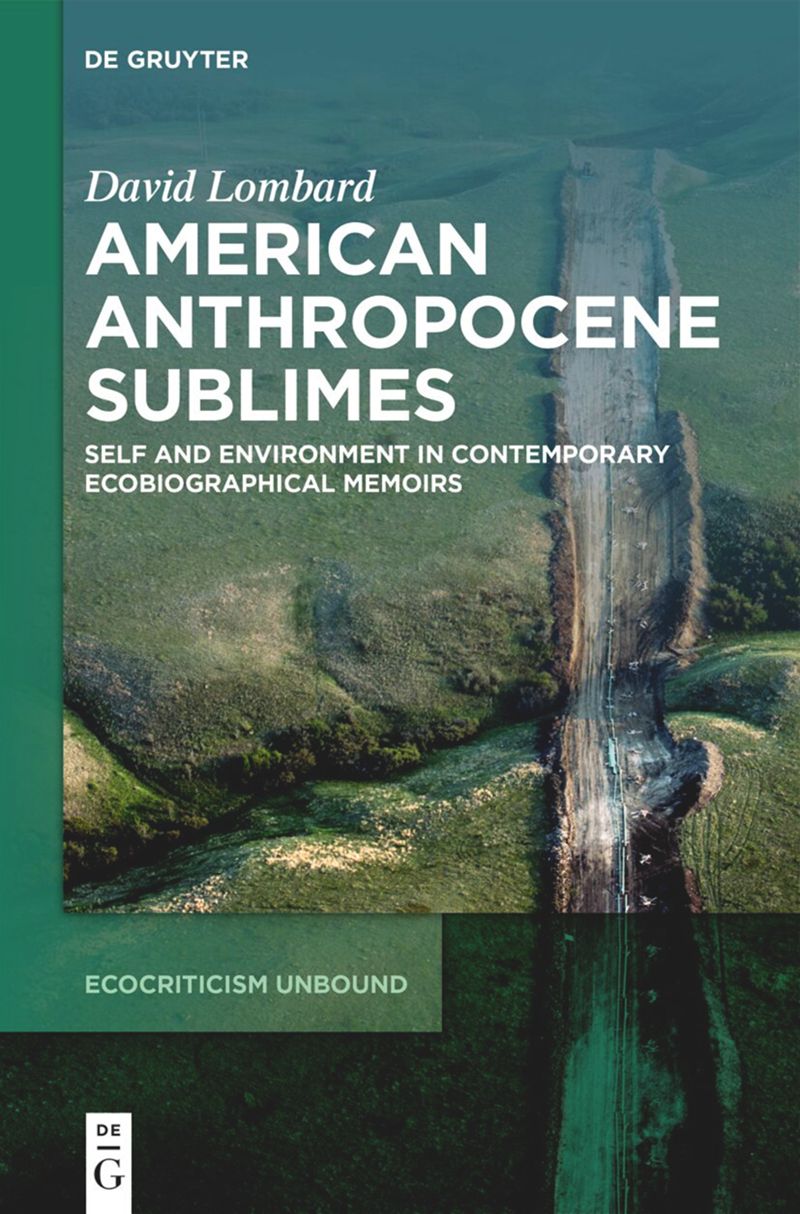
American Anthropocene Sublimes: Self and Environment in Contemporary Ecobiographical Memoirs. Berlin, Germany: De Gruyter, 2026. ISBN: 978-3-11-222468-7
About this book
The environmental memoir has become a culturally prominent literary form and provides an ideal site for investigating the shifting destinies of the concept of the sublime in the context of ecological crises and the Anthropocene. This book explores the affordances and limits of the sublime as a means of representing environmental crises and human–nonhuman relationships in contemporary American memoirs. More specifically, it examines what it terms contemporary U.S. ecobiographical memoirs, showing how they reconfigure the traditional sublime by deploying and reshaping it to depict mountains and mountaineering, hunting, agriculture, atomic power, and oil extraction. In doing so, it engages with a broad range of affects—not only the sublime but also the eerie and the ‘stuplime’—as well as ecological categories such as the haptic and toxic sublime, making a theoretically ambitious intervention in contemporary debates on literature and environmental crisis.
Purchase the book here (available on November 2, 2026).
Endorsements:
“Lombard delivers detailed analyses of memoirs across a wide range of writers, from mountain-climbers, hunters, and farmers to workers in the nuclear and oil industries, with impressive erudition in a highly readable style. Skillfully combining the study of affect with narratology, he foregrounds that the sublime continues to surface in unexpected places in the Anthropocene – not just in the mountains, forests, and farms of conventional nature writing, but also at oil drilling sites and nuclear power plants. His focus on memoirs that have not to date been considered as part of the environmental literature canon provides a welcome expansion of ecocritical objects of study. American Anthropocene Sublimes makes important contributions to ecocriticism, the study of life writing, memory studies, and studies of place.” —Ursula K. Heise, University of California, Los Angeles, USA
“American Anthropocene Sublimes: Self and Environment in Contemporary Ecobiographical Memoirs is a richly researched and theoretically wide-ranging study of the practices and histories of twentieth-century American ‘ecobiographical memoirs.’ Applying concepts of the sublime to ecological texts and theories, Lombard productively intervenes in conversations about the Anthropocene. His rhetorically probing examination of memoirs in locations ranging from the nonhuman worlds of mountains and animal species to practices of agricultural production, nuclear risk, and environmental toxicity insightfully proposes new terms and terrains for investigating the work of ecological life writing now.” —Julia Watson, The Ohio State University, USA
Techno-Thoreau: Aesthetics, Ecology and the Capitalocene. Macerata, Italy: Quodlibet, 2019. ISBN: 9788822903709
About this Book
This essay serves the double purpose of investigating the aesthetic dimensions of Thoreau’s environmental philosophy while examining the philosophical and political implications of its capacity to break down the boundaries between the natural and the technological landscape. Deeply rooted in an Emersonian transcendentalist tradition viewing nature as an organized and holistic “whole,” Thoreau’s ecophilosophy seeks to reconcile the idealistic pole with the empirical pole in its approach to natural and technological landscapes, objects and situations. Consequently, this book starts by considering Thoreau as a “techno-author” who does not shun from embracing technological change in the Romantic period and proceeds to develop an alternative, proto-ecocritical form of the aesthetic of the sublime. It also calls for a reconsideration of Thoreau’s poetics and its legacy against the background of the “toxic sublime,” which sheds a new light on the methods and purposes of ecocriticism as well as on recent trends in environmental (non)fiction.
Purchase the book here.
Accolades and Reviews:
Shortlisted for the 2020 ESSE Book Award (Category B – Junior Scholars)
“Overall, one can argue that Lombard’s book brings a fresher outlook to American nature writing by explicating the relations between nature, power, and capital, and by employing a deconstructive methodology that highlights the boundary breakdowns between the natural and the technological landscape.” (Başak Ağın, Ecozon@, 11.1, April 2020, pp. 210-12, full review)
“David Lombard’s study succeeds in creating a broad, complex analysis of Thoreauvian and post-Thoreauvian literature.” (Călina-Maria Moldovan, Metacritic Journal for Comparative Studies and Theory, 6.1, July 2020, pp. 194-99, full review)
“Resituating man in nature is a task that bears repeating and Lombard’s analysis of Thoreau’s ‘toxic sublime’ offers a welcome reminder that Thoreau was committed to precisely this task.” (Rachael DeWitt, The Thoreau Society Bulletin, 311, Fall 2020, p. 10, JSTOR link)
“The interesting essay Techno-Thoreau […] proposes a reading of the philosopher so as to ‘break down the boundaries between the natural landscape and the technological landscape’; and therefore an approach between a divinized nature and a technology that has become incomprehensible (and therefore, in some ways, magical).” (Vanni Santoni, Linus, September 2019, full article)
“It is not just a question of narrating the apocalyptic consequences of the climate crisis, nor of invoking a return to nature (the title of the essay by David Lombard, Techno-Thoreau, Quodlibet, 2019, is eloquent with respect to this paradigm shift which makes the work of an author-fetish of ecocriticism react with the most current theoretical variables.” (Niccolò Scaffai, Domenica – Il Sole 24 Ore, January 2020, full article)